
If you are trying to get stunning shots of birds in the wild, having the right lens is a game changer.
Birds rarely stick around for long, so reach, autofocus speed, and image quality matter a lot.
Whether you are aiming for your first kingfisher or planning a trip to photograph eagles, I have put together my top lens picks for bird photography in 2026, from affordable options for beginners to pro level glass that makes every feather pop.
Quick Picks: Best Lenses for Bird Photography (2026)
For anyone in a rush, here are my favorite lenses for bird photography right now:
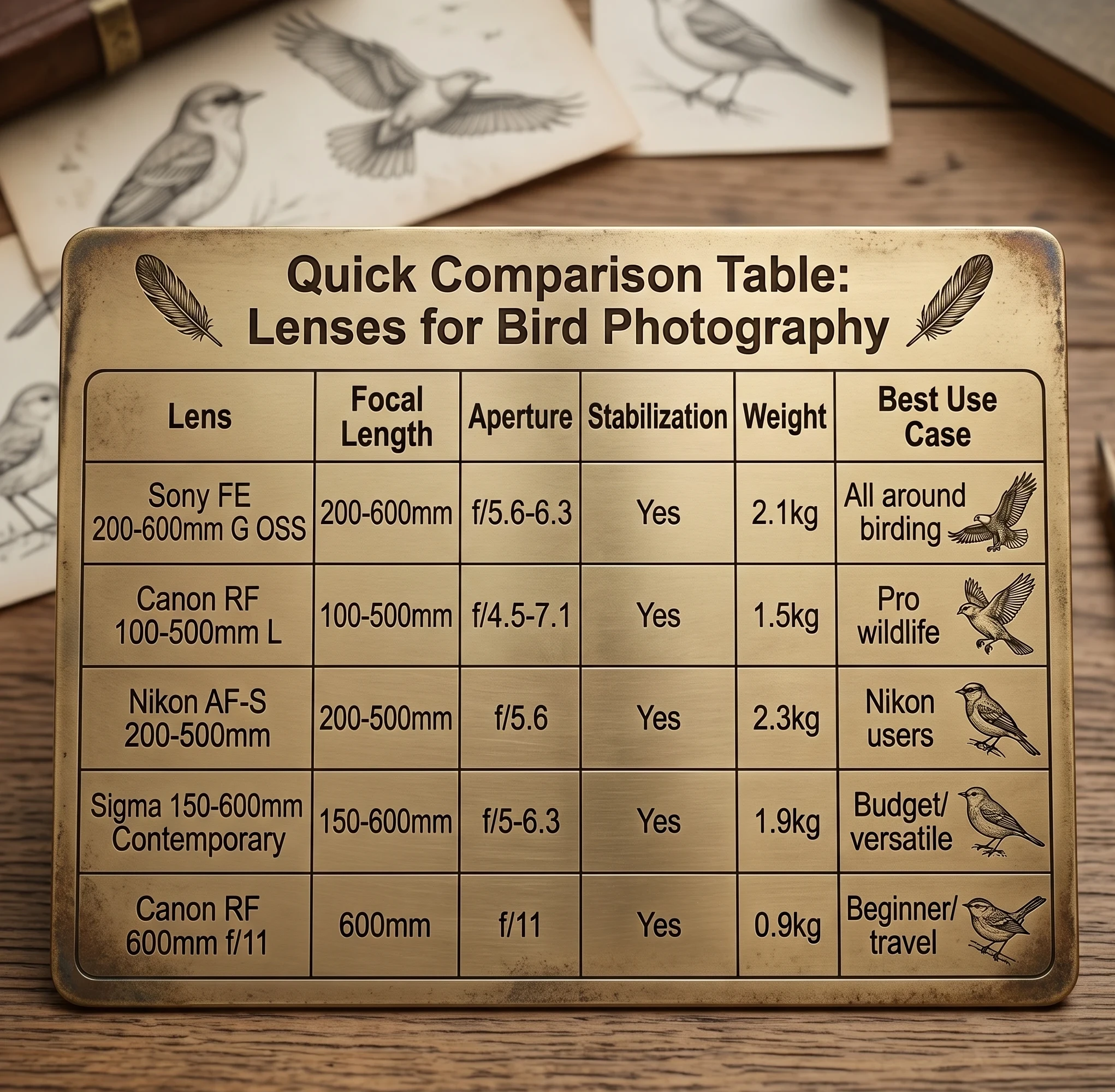
- Best overall: Sony FE 200-600mm f/5.6-6.3 G OSS
- Best for pros: Canon RF 100-500mm f/4.5-7.1 L IS USM
- Best for Nikon: Nikon AF-S 200-500mm f/5.6E ED VR
- Best on a budget: Sigma 150-600mm f/5-6.3 Contemporary
- Best for beginners: Canon RF 600mm f/11 IS STM
These picks cover the most popular camera brands and price points.
If you’re not sure which lens fits your needs, I will break down what makes each one special below.
What Makes a Lens Great for Bird Photography?
Catching fast moving birds is not easy, so the right gear really helps. There are a few things I watch out for when recommending bird photography lenses:
- Focal length (reach): At least 300mm if you want to photograph birds at a distance. 400–600mm hits the sweet spot for most situations.
- Autofocus performance: Birds move unpredictably. Quick, accurate autofocus is super important for getting sharp results, especially with birds in flight.
- Image stabilization: Comes in handy for shooting handheld, especially when dealing with longer, heavier lenses.
- Aperture: Wider apertures (lower f/numbers) let in more light and can help blur the background for nice separation. F/5.6 to f/6.3 lenses usually balance weight and affordability.
- Weight and portability: A lighter lens means you can walk longer and react faster to fleeting moments. If you are hiking into remote places, this might be the deciding factor for which lens comes with you.
Best Lenses for Bird Photography: Detailed Picks
Sony FE 200-600mm f/5.6-6.3 G OSS – Best Overall
Sony’s 200-600mm stands out for birders using the Sony system.
The 600mm reach is a huge advantage for small, distant birds, and the zoom design means you are ready for close up and far off subjects without swapping glass in the field.
- Why this lens is worth checking out: Versatile reach, sharp images across the range, internal zoom (so the length stays the same while zooming), and speedy, silent autofocus that keeps up with action.
- Bird photography performance: Tracking birds in flight is easy with this one, especially when paired with a Sony camera’s real time AF tracking. It is simple to hand hold (for a super telephoto), and I have used it for everything from garden songbirds to eagles overhead.
- Pros: 600mm reach, sharp across the range, great built in stabilization, weather sealed
- Cons: Not a small lens (just over 2kg), works best with Sony mirrorless bodies
Check current prices and stock, especially during peak birding seasons.
Canon RF 100-500mm f/4.5-7.1 L IS USM – Best Premium Zoom
If you are using Canon’s newer mirrorless cameras, this L series zoom is outstanding.
For travel or longer treks, it is surprisingly easy to carry and delivers excellent image quality.
- Why this lens is worth checking out: Covering everything from large waterfowl to smaller birds in the brush, this lens offers crisp optics and impressive build. There is enough reach for most birding situations and strong image stabilization for handheld shooting.
- Best for: Canon mirrorless users chasing pro level sharpness without the massive weight or price of a dedicated prime lens.
- Pros: Lighter than most superzooms, fast autofocus, weather sealed, rugged
- Cons: Narrower max aperture at 500mm (f/7.1), premium price
Nikon AF-S 200-500mm f/5.6E ED VR – Best for Nikon Users
Long a favorite with Nikon wildlife shooters, this lens offers a good balance of price, reach, and a constant f/5.6 aperture.
If you use a Nikon DSLR, it is a robust option for both beginners and experienced birders.
- Why this lens is worth checking out: Along with 500mm reach, you get stable, sharp images and solid autofocus in a relatively affordable package. It also works with Nikon’s APS C cameras, giving even more effective reach (up to 750mm equivalent).
- Pros: Constant f/5.6 aperture, good stabilization, compatible with many Nikon bodies
- Cons: A little heavy for some, requires an adapter for Nikon mirrorless cameras
Sigma 150-600mm f/5-6.3 Contemporary – Best Budget Lens
Sigma’s 150-600mm “C” lens stands out for value.
For the reach you get, it offers much for its price and is available for most camera mounts.
- Why this lens is worth checking out: Get up to 600mm without spending a large sum. It is a popular pick for anyone after a budget telephoto lens for bird photography without sacrificing too much on image quality or autofocus.
- Pros: Super affordable, sturdy build, flexible zoom range, surprisingly quick autofocus
- Cons: Not as sharp as the pricier alternatives, focus ring can feel a bit loose, weightier than it seems
Canon RF 600mm f/11 IS STM – Best Lightweight Prime
This unusual lens is all about convenience.
The f/11 aperture puts off some advanced photographers, but its light weight and 600mm reach make it a good option if you want to pack less or are starting out.
- Why this lens is worth checking out: Perfect for longer bird walks or fitting in travel bags. Sharpness is above expectations for this price range, and autofocus is whisper quiet and fast.
- Best for: Anyone seeking an ultralight, simple setup for daytime birding on Canon’s RF mount cameras.
- Pros: Featherlight, easy to carry, budget friendly, built in stabilization
- Cons: Fixed aperture f/11 (needs good light), fixed focal length so less flexible
Prime vs Zoom Lenses for Birding
- Prime lenses: Offer excellent sharpness, sometimes lighter, but you are limited to a single focal length.
- Zoom lenses: Flexible and forgiving for framing, better suited to fast moving, unpredictable birds. These are what I usually suggest for anyone just getting started in bird photography.
Zooms provide plenty of flexibility, especially when you are still figuring out your favorite birding locations.
Pros often use both: a zoom for general shooting and a prime for situations where top sharpness or low light is necessary.
How to Choose the Right Lens for Bird Photography
- Double check your camera mount: Not all lenses are compatible with every camera. Make sure the lens matches your camera brand or have the right adapter.
- Choose the best focal length: Most birders do well with at least 400mm, but 500–600mm helps with small or far off birds.
- Sort out your budget: Higher cost lenses tend to have faster autofocus and better weather sealing, but there are affordable options for hobbyists that work very well.
- Think about weight: If you plan to hike a lot, look for lighter choices. The Canon RF 600mm f/11 or compact zooms work best for longer expeditions.
- Consider stabilization: If your camera does not include stabilization, it is extra useful to have it in the lens for handheld use.
Check out current deals or lens stock with a quick search at your favorite camera store before buying.
Some offers last just a few days, especially during spring when bird photography gets popular.
Best Cameras to Pair with Bird Photography Lenses
Fast, reliable autofocus is as important as the right lens.
Mirrorless cameras with advanced AF tracking (like Sony’s a7R V or Canon’s R5) perform exceptionally, especially with the modern lenses above.
APS C cameras are also helpful—their crop factor gives you extra reach; a 600mm lens works like a 900mm on many models!
For beginners, virtually any camera released in the last five years with a decent continuous shooting mode will work well for birding when paired with a quality lens from this list.
Common Mistakes in Bird Photography Lens Choice
- Choosing lenses under 300mm: Birds will usually appear tiny in your photos, especially with full frame cameras.
- Ignoring lens weight: A heavy lens can cut a trip short. Always check the weight before buying, and if possible, try one at a local camera store.
- Overlooking stabilization: Even if you always use a tripod, stabilization helps dampen vibrations when handholding or panning for birds in flight.
FAQ: Best Lenses for Bird Photography (2026)
What focal length is best for bird photography?
For most cases, 400–600mm is your best bet. This offers reach for small or nervous birds while letting you stay at a comfortable distance.
Are zoom lenses good for bird photography?
Absolutely. The extra flexibility makes it easier to track and frame birds as they move around, especially for beginners.
What is the best budget lens for bird photography?
The Sigma 150-600mm f/5-6.3 Contemporary has been popular for years. It works on most camera mounts, covers a huge focal range, and costs less than many other supertelephoto choices.
Is more expensive always better?
Bigger budgets get you better autofocus, weather sealing, and optical quality. Still, I have seen plenty of beginner birders capture eye catching shots with cheaper lenses—they may just need a bit more patience or extra editing in challenging light!
Final Thoughts
Picking the right lens for bird photography means balancing reach, image quality, portability, and your budget.
Whether you are photographing backyard robins or venturing to Costa Rica for exotic species, one of these lenses will give a boost to your birding adventure.
Always check prices and local availability before buying; sometimes the best lens is the one ready to go for your next outing!
This guide is incredibly helpful, especially the way you broke down focal length, autofocus performance, and stabilization. One thing others might appreciate too is testing how a lens balances on their specific camera body — sometimes a lens that looks perfect on paper can feel front‑heavy in the field. Your explanations make the decision process much clearer for beginners and hobbyists.
Hi Kiersti,
“Testing how a lens balances on their specific camera body” — yes.
That is the line I should have bolded in the guide. Thank you.
Specs do not tell you your wrist will be screaming at hour 3 because your R7 + 200-800mm is nose-diving. Focal length, AF, stabilization — those get you the shot.
Balance gets you through a full morning in the field without physio bills.
You are exactly right: perfect on paper ≠ perfect in hand. A 150-600mm on a Z8 feels different than the same lens on an R10.
Weight distribution, grip depth, even where the tripod collar sits changes everything when you are tracking a Merlin at 7am.
For anyone reading: The “Parking Lot Test” before you buy/rent: Mount it + strap it: Hold the combo like you would in the field — left hand under lens foot, right on grip — for 2 minutes straight.
If your left wrist shakes, it is too front-heavy for handheld work.Track a car: Pan left to right following cars. If the nose dips every time you stop, balance is off.
You will miss birds banking.
Vertical test: Flip to portrait. Does the lens try to rotate in your hand? Bad balance = missed vertical compositions.
Bag test: Can you pull it out + raise to eye in 3 seconds? If you are fighting the rig, you are missing the kingfisher dive.“Decision process much clearer for beginners and hobbyists” — that was the goal.
Gear anxiety is real. Your balance tip just saved someone a $2,500 return. Because once you buy, you adapt to the pain instead of admitting the setup is wrong.
Rent before you marry.
Test in the parking lot, not on a once-in-a-lifetime trip.
Thanks for making this guide better, Kiersti. “Front-heavy in the field” is going in the 2026 update as its own callout box.
What body + lens combo are you running now?
If you share it, I will tell you the #1 balance hack for that specific rig.
Best regards,
Raymond